Open 6:30 am to 6:30 pm, Monday to Friday, 52 weeks a year

Buffalo 03 9999 7944Ballan 03 9087 3977

Our philosophy

Why Montessori?

Taught for more than 100 years and chosen by families all over the world, the Montessori method follows the child: their needs, their interests and their own pace.

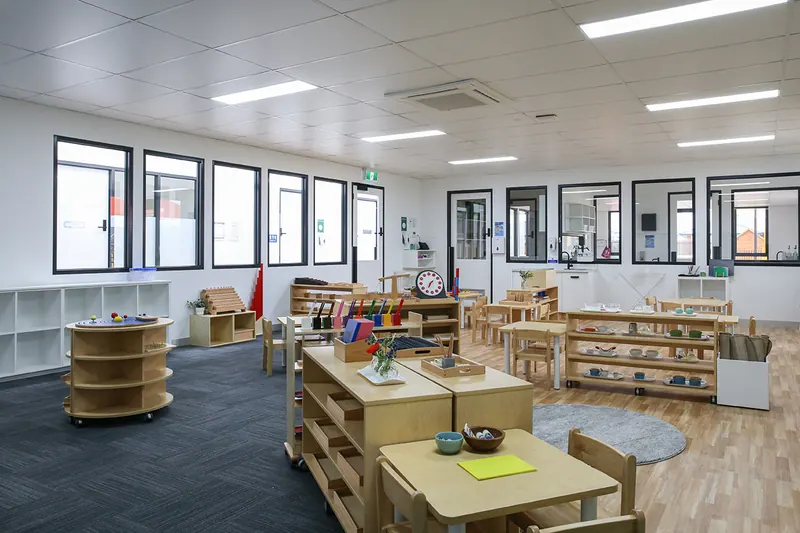
Prepared Montessori environment with open shelves, work tables and floor mats

What is Montessori?

In 1907, drawing on scientific observation of how children naturally learn, Dr Maria Montessori developed the Montessori method of education. It is based on self-directed activity, hands-on learning and collaborative play.

Influenced by her discovery that children teach themselves, she designed the “prepared environment”, where children freely choose from an array of developmentally appropriate exercises and activities. The classroom's specially designed materials are inviting and beautiful to look at, which draws each child into their own active learning and individual choice.

The materials encourage self-discipline, independence, concentration and motivation, and they feed a child's innate desire to learn, all with the guidance and support of a qualified Montessori teacher.

The role of the educator

In a Montessori room the focus is on the children's learning, not the teacher's teaching. A Montessori ‘director’ guides children in their own active learning, quietly observes each child throughout the day, and takes care not to interrupt a child at work.

Help is given when a child wants or needs it. That restraint is deliberate: it builds independence and real pride in a child's own work.

Alongside our Montessori teachers we employ early childhood educators, and our programs incorporate the Early Years Learning Framework (EYLF).

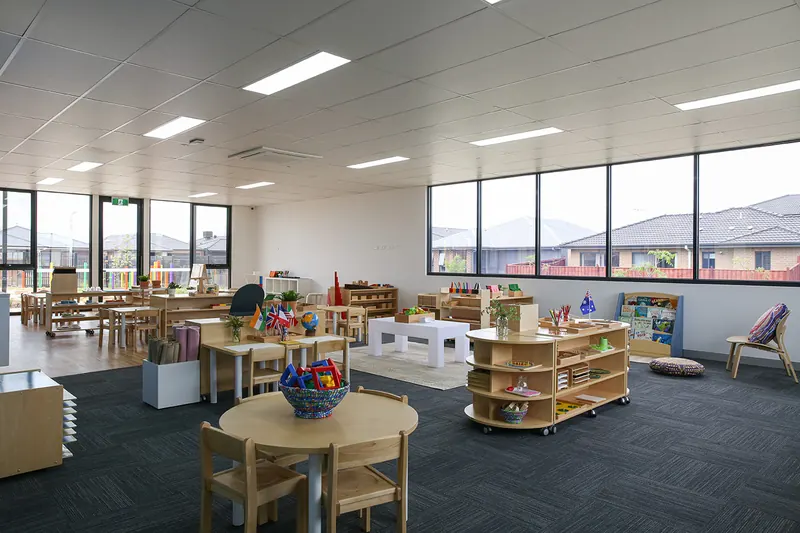
Montessori classroom filled with natural light from floor-to-ceiling windows

The benefits

Why it works for young children

  • It focuses on the individual child. Children learn at their own pace and move to the next step only when they are ready.
  • A child-centred environment. Children work independently, with occasional group times.
  • A responsive, prepared environment. Everything is within reach, and materials are always presented neatly so they are inviting to the child.
  • Materials that change with the children. When the group has mastered an exercise and it no longer stimulates them, it comes off the shelf and something new takes its place.
  • Every material has a purpose. The Knobbed Cylinders, for example, introduce shape, depth and size while refining fine motor skills and the pincer grip.

Inside every classroom

The five Montessori learning areas

Each room is arranged into five areas. Together they support a child's emotional, physical, cognitive, language and social development.

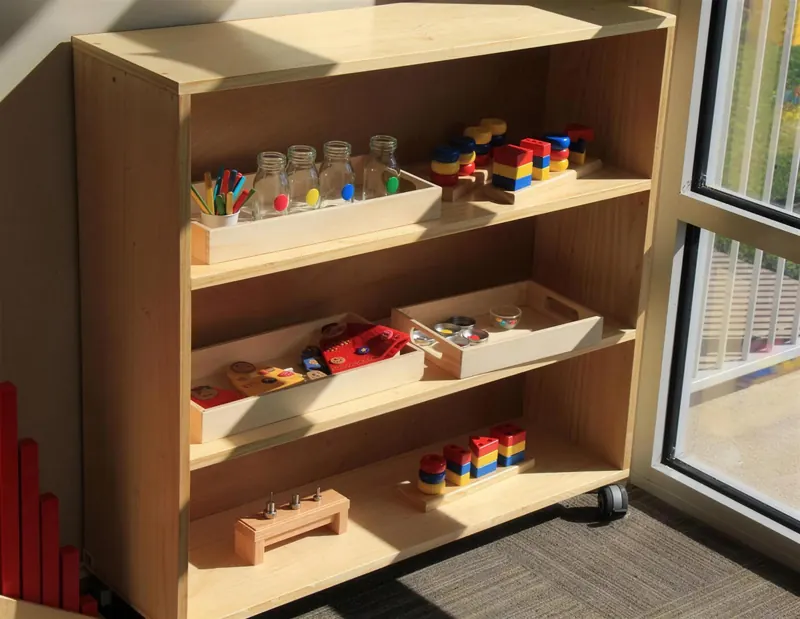
Shelf of practical life and sensorial materials

Practical Life

Children have a natural interest in activities they have seen adults carry out. Practical Life exercises resemble everyday tasks that are useful and purposeful, in four groups:

  • Preliminary applications: pouring, spooning, carrying a tray
  • Care of the person: washing hands, zipping a coat, polishing shoes
  • Care of the environment: sweeping, washing dishes, washing a table
  • Grace and courtesy: greeting someone, saying thank you, how to interrupt politely

These exercises refine motor skills, concentration and intellect, and develop a sense of order and independence.
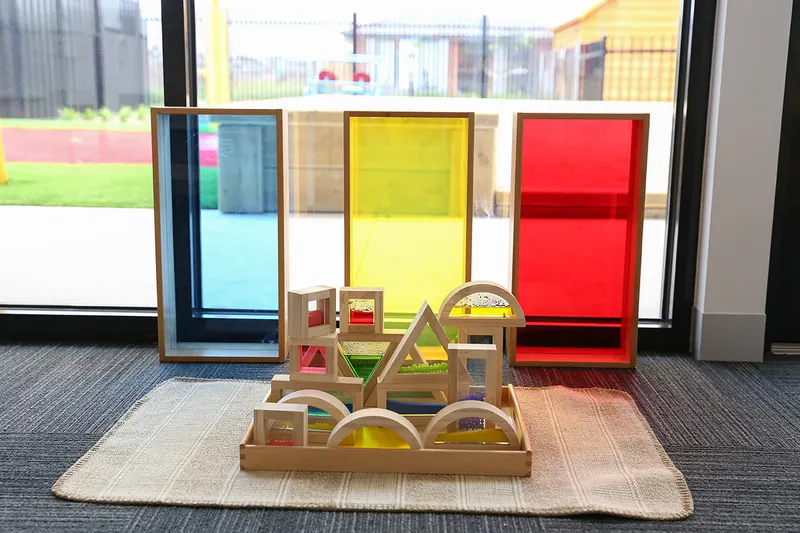
Translucent colour blocks and light panels from the sensorial area

Sensorial

Sensorial materials isolate qualities the senses can recognise: texture, shape, size, weight, temperature, loudness and softness, and matching.

They help children gather clear, precise information so they can classify the things around them, which in turn helps them adapt to their own environment.

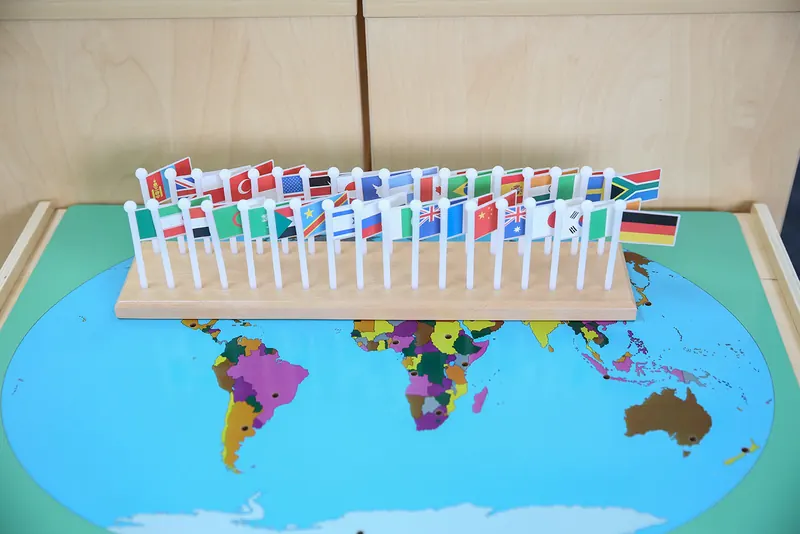
Montessori world puzzle map with a row of national flags

Culture

Geography, science, art, music, botany and zoology all live in the Culture area of the classroom.

These subjects give children a better understanding of our world and the many cultures, creatures and landscapes they will meet throughout their lives.

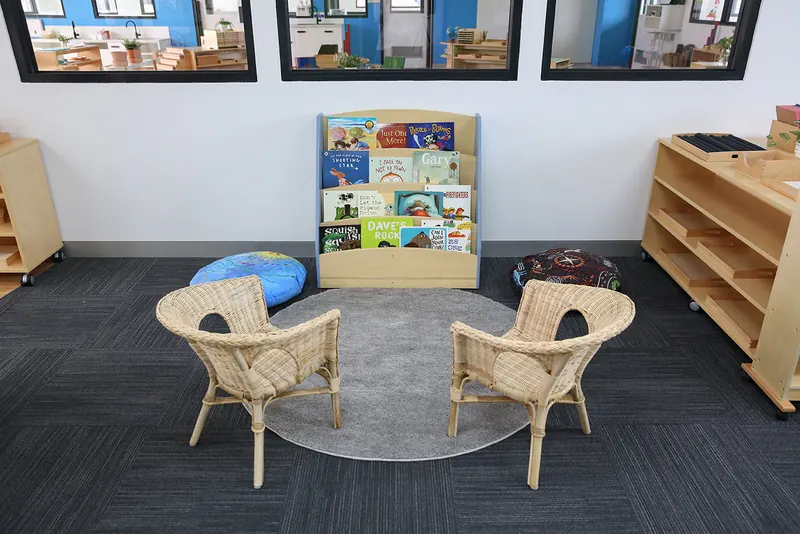
Quiet reading corner with cane chairs and a forward-facing bookshelf

Language

The classroom is designed so each child learns at their own pace. In the Language area, materials help children develop and master communication and self-expression.

The educator is the child's main support in language development and helps build their self-confidence.

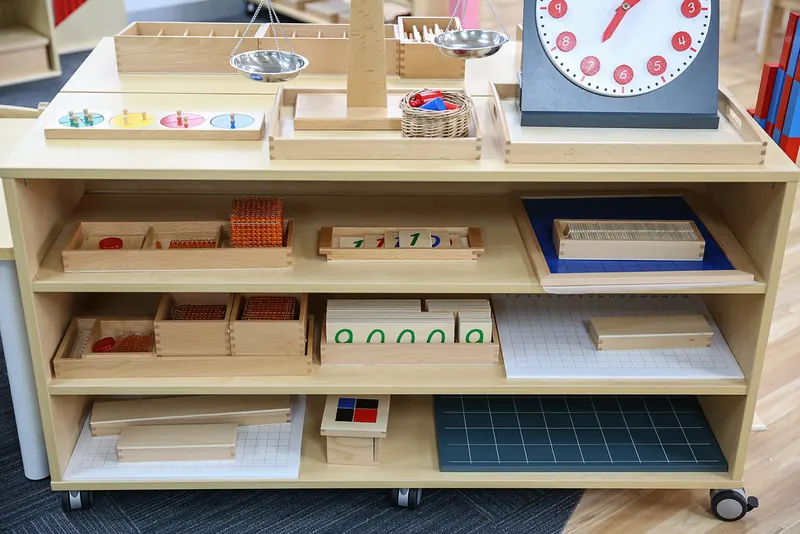
Maths shelf with number rods, sandpaper numerals, a clock and counting materials

Mathematics

Mathematical ideas are first experienced through the Sensorial materials, which give a sense of order and indirectly introduce the decimal system, grading, dimension and length.

From there, maths in a Montessori classroom starts with the concrete and moves step by step towards the abstract.

“The most important period of life is not the age of university studies, but the first one, the period from birth to the age of six.”
Maria Montessori

Montessori questions, answered

What is the Montessori method of education?

Developed by Maria Montessori, an Italian educator, in the early 1900s, it is an approach that emphasises self-directed learning and hands-on activity. It is now used around the world.

How is Montessori different from traditional childcare or preschool?

Montessori classrooms foster independence, choice and respect. Children choose their activities, work with specially designed materials, and are guided by educators who observe and support each child's learning journey, rather than following a one-size-fits-all curriculum.

How do you assess a child's progress in a Montessori classroom?

Rather than formal tests or grades, teachers use their observations to understand each child's needs, documenting progress in academic, social and practical skills.

Is Montessori suitable for all children?

Yes. Montessori supports children of all abilities, backgrounds and learning styles. The approach is flexible and inclusive, allowing every child to thrive.

Come and see a Montessori classroom at work

Tours run Monday to Friday at 10:30 am, by appointment, at both campuses. We will do our best to fit the day you choose.